What is a SOC - explained simply
Picture a night watchman who stays awake while you sleep. He doesn't build fences or install locks — that was done earlier. His job is different: to watch, to notice, and to react in time. If he spots movement by the warehouse at two in the morning, he doesn't wait until sunrise — he checks what's happening and raises the alarm if needed.
That is exactly how a SOC works. So what is a SOC? A Security Operations Center is a team of people, processes, and tools that continuously monitors an organization's digital environment: the network, computers, servers, and systems. Its goal is to spot a break-in — or an attempt at one — as early as possible, while it is still a minor event rather than a business-stopping incident.
Why locks and fences aren't enough
Most organizations picture cybersecurity as protective measures: a firewall, antivirus software, passwords. These matter — but they are only locks and fences. They deter some attackers, yet they don't answer the essential question: what is happening right now?
Antivirus software stops a known malicious file. But it won't notice that someone successfully logged into your accountant's user account from abroad on a Sunday night, quietly browsed documents for an hour, and downloaded copies. Formally — no virus, no break-in alert. Just unusual behavior, which can only be noticed by someone who is watching.
There is plenty of time for that: according to Mandiant's M-Trends 2026 report, a median of 14 days passes between a break-in and its detection, and espionage attacks go unnoticed for four months on average. All that time, attackers explore systems, collect data, and prepare for the main strike — for example, encrypting your data and demanding ransom. The earlier they are noticed, the cheaper and simpler the whole story.
In 2023 dwell period (time from attacker accessing the systems until the detection) was 10 days, in 2024 - 11 days, in 2025 - 14 days
What does a SOC actually do?
SOC work breaks down into several continuously running activities. No magic — just systematic vigilance.
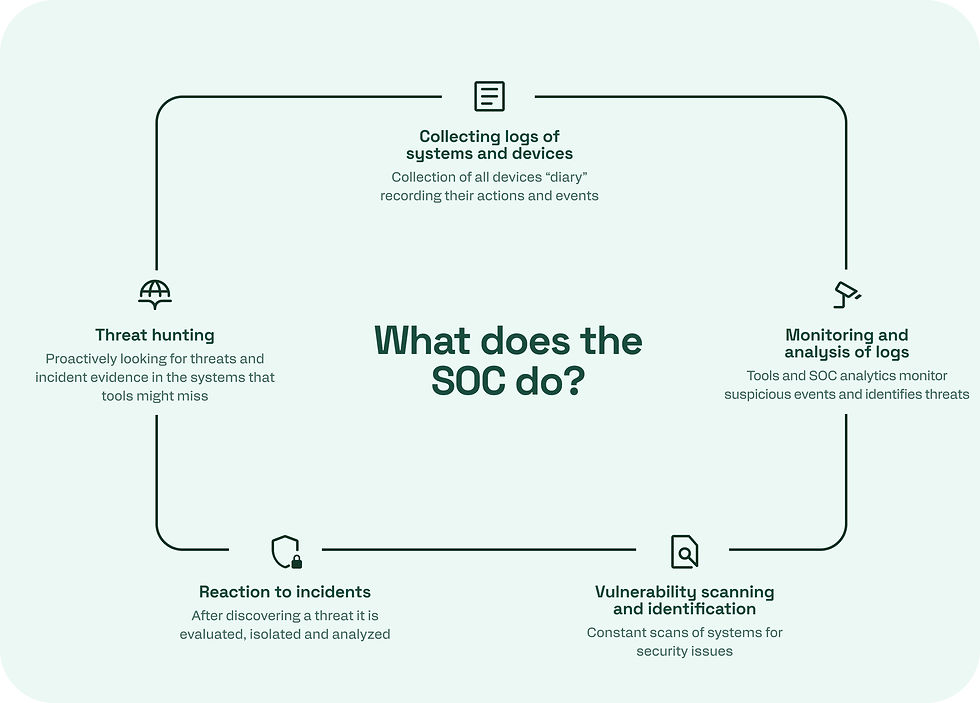
Collects and stores event logs
Every computer, server, and system constantly writes a "diary" — event logs: who logged in, when, from where, what was changed. The SOC collects these logs centrally and stores them for several months.
Why does this matter? For two reasons. First, without logs there is no analysis — they are the night watchman's eyes. Second, when an incident happens, logs answer the questions "how did the attackers get in?" and "what did they reach?". Without them, investigating an incident is like searching for the cause of a fire in the ashes.
Analyzes and monitors
Collected logs are analyzed by automated tools, and suspicious signals are reviewed by people — SOC analysts. It takes a human to tell whether a login from another city is an employee on a business trip or a stranger with a stolen password.
Monitoring can run during business hours or around the clock (24/7). The difference is simple: attackers prefer nights, weekends, and holidays — precisely when nobody is looking. The FBI and the US cybersecurity agency CISA have issued a dedicated advisory about this: the most damaging ransomware attacks are launched on holidays and weekends, when offices are empty.
Scans for vulnerabilities
A vulnerability is a security gap in a system through which an attacker can get inside: outdated software, a misconfigured server, a forgotten test account. The SOC regularly scans the organization's systems and finds such gaps before attackers do. Think of the watchman walking the grounds, checking that every door is locked — and reporting the one left ajar.
Responds to incidents
When a threat is detected, the SOC assesses its severity, informs the organization, and helps contain the situation: isolating the affected computer, blocking the attacker's access, figuring out what happened. Contracts usually define this as response time — how many hours after detection the response begins.
It's important to understand the boundary here: the SOC is the watchman and the first responder, but not the organization's entire IT department. Containing an incident is a joint effort of the SOC, the organization's leadership, and the IT team, each with its own role. That is why incident preparedness — plans, contacts, responsibilities — must be in place in advance.
Hunts for threats
The most mature SOC activity is threat hunting: instead of waiting for automated alerts, analysts actively search for traces of intrusion that the tools may have missed. Returning to the watchman analogy — he doesn't just react to motion sensors; he shines his flashlight into the darkest corners himself.
What does this look like in practice?
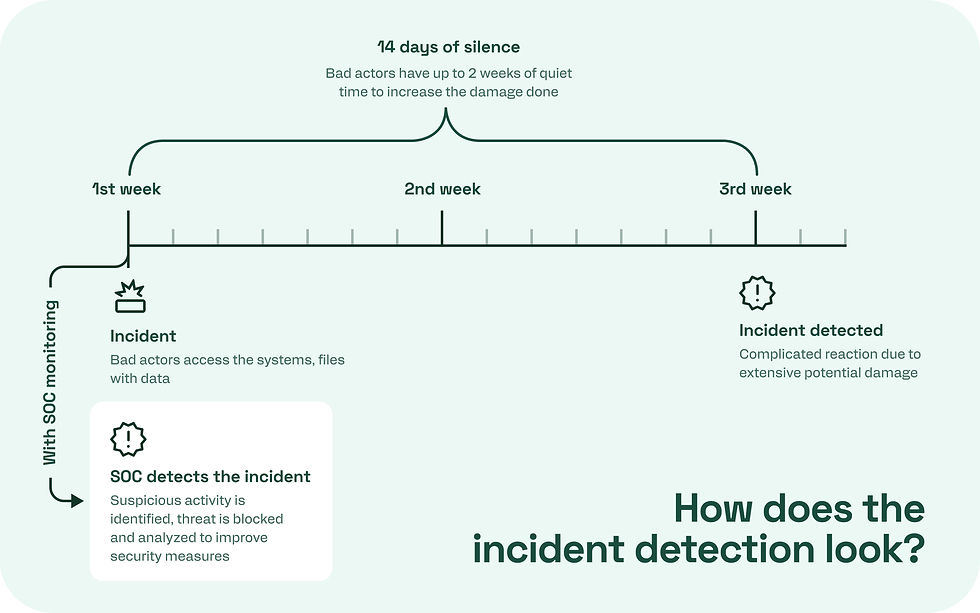
Imagine a typical situation. Friday evening, everyone has gone home. At a manufacturing company, the accountant's user account suddenly connects to the file server and downloads several hundred documents in half an hour — while the accountant herself is planting strawberries at her summer cottage, and normally opens just a few files a day.
Without monitoring, this event would go unnoticed until Monday — and most likely much longer, because nobody reviews logs just in case. A SOC analyst sees the signal that same evening: unusual time, unusual volume, unusual behavior. He reaches out through the agreed channel, the account is temporarily blocked, the password is changed. On Monday it turns out the accountant had entered her credentials on a fake "system update" page a week earlier — a classic phishing case.
The difference between these two scenarios is not technology. The systems were identical in both. The difference is whether anyone was watching.
"Can't our IT person just do this themselves?"
This is the question we hear most often from SME executives. And it's perfectly logical — the IT administrator already maintains the systems.
But it's worth separating two different jobs. The IT administrator's task is to keep everything working: computers boot, email flows, servers run. The SOC's task is to keep everything working safely — more precisely, to notice when something is working in a way it shouldn't. These are different competencies, different tools, and, most importantly, different time: monitoring cannot be a job done "when there's time left over from the main work."
There is also a subtler reason. If the same person both configures the systems and evaluates their security, they are checking their own work — and people naturally don't see their own mistakes. An independent set of eyes notices what the internal eye has grown used to.
A SOC and a chief security officer are not the same thing
If you've read our earlier posts, you know the comparison: the chief security officer (CISO) is the organization's security architect — designing, advising, and overseeing the whole. In this analogy, the SOC is the night watchman: daily, uninterrupted monitoring and response.
An architect without a watchman knows how the house should be kept safe, but doesn't see what's happening inside it tonight. A watchman without an architect sees the events, but nobody puts together the big picture: which risks matter most, what to change in processes, how to meet legal requirements. The strongest result comes when the two work together and talk to each other. More on that in our next post.
CISO (security architect) | SOC (security guard) | |
In essence | Designs cybersecurity as a whole | Watches and monitors systems daily |
Answers the question | How should things be kept safe? | What is happening in the systems right now? |
What is being done? | Risks, policies, compliance, training | Logs, analysis, responding to threats and incidents |
Work rhythm | Strategic - in monthly and yearly cycles | Tactical - 9/5 or 24/7 |
Without it, you're left with | Various cybersecurity events without big picture or clear direction | A cybersecurity plan that nobody watches over |
What does the law say?
Lithuania's Cybersecurity Law (KSĮ, transposing the EU NIS2 directive) requires covered organizations to have not only protective measures but also the ability to detect and manage incidents: collect and store event logs, monitor networks and systems, and report an incident to the NKSC (Lithuania's National Cyber Security Centre) within 24 hours of identifying it.
In practice this means something simple: if nobody is monitoring your systems, you simply won't notice an incident — and you won't report it in time. Continuous monitoring has moved from "nice to have" to a legal requirement for many organizations in Lithuania.
Does every organization need the same thing?
No. SOC services typically come in tiers — from basic to fully managed — and that's a good thing: a small organization doesn't need (and shouldn't pay for) the same coverage as a critical infrastructure operator.
The basic tier usually covers log collection, storage, and monthly reports — the minimum foundation the law requires. From there, tiers add continuous log analysis and monitoring during business hours or 24/7, regular vulnerability scanning, faster response times, and incident investigation. At the highest tier — active threat hunting and the ability to remotely isolate infected devices before the threat spreads across the network.
What matters most is choosing a tier based on your business risks and legal obligations — not on the principle of "take the cheapest one, just to have something." This is where a chief security officer's (CISO's) perspective pays off: they help assess what the organization actually needs.
Three questions worth asking today
Whether or not you're considering a SOC, every executive should know the answers to these questions. Ask your IT team or service provider:
Are we collecting event logs from our most important systems — and how long do we keep them? If the answer is "I don't know" or "probably," there will be nothing to reconstruct events from when an incident happens.
Who would notice an unusual login on a Friday night — and how quickly? "On Monday, when we get to work" is an honest but expensive answer.
If an incident happened tomorrow — would we know what to report to the NKSC within 24 hours? You must report not "something," but what happened and what the impact is. Without logs and monitoring, that question cannot be answered.
If the answer to even one of these is missing — that's not a reproach, just a map of your current situation. And that is exactly where you start.
The watchman who stays awake while you sleep
For a long time, cybersecurity was understood as one-off tasks: install, configure, document. The SOC reflects a different, more mature view — security is a continuous process that needs eyes on duty. And since maintaining your own round-the-clock team doesn't pay off for an SME, the natural path is to share: an external SOC monitors several organizations, and each pays only a fraction of the team's cost.
Cybersecurity is a continuous process, not a one-off task
If the Cybersecurity Law sets continuous monitoring requirements for your organization — or you simply want to know what's happening on your network at night — let's talk. Combined with our external CISO service, this gives you both strategy and daily monitoring from a single team.


